RAG for Small Business: How This AI Technology Creates Smarter Chatbots
If you've played with ChatGPT, you've seen the power (and the danger) of modern AI. It can write a poem about your dog in seconds, but if you ask it for the specific pricing of your "Gold Package" or your business's refund policy, it will either say "I don't know" or, worse, it will hallucinate—inventing an answer that sounds confident but is completely wrong. For a small business, "hallucinations" aren't just a quirk; they are a liability. You cannot have an AI telling customers they can have a 90% discount just because the model felt generous that day. This is why RAG (Retrieval-Augmented Generation) is the most important acronym you need to learn in 2025. RAG is the technology that tells the AI: "Stop guessing. Read these documents first." In this guide, we’ll explain RAG for business in plain English, show you how it works, and explain why it’s the secret to building an AI assistant that actually helps your customers without the risk.
Table of Contents
- What is RAG? (The Librarian Analogy)
- RAG vs. Fine-Tuning: Which is Better?
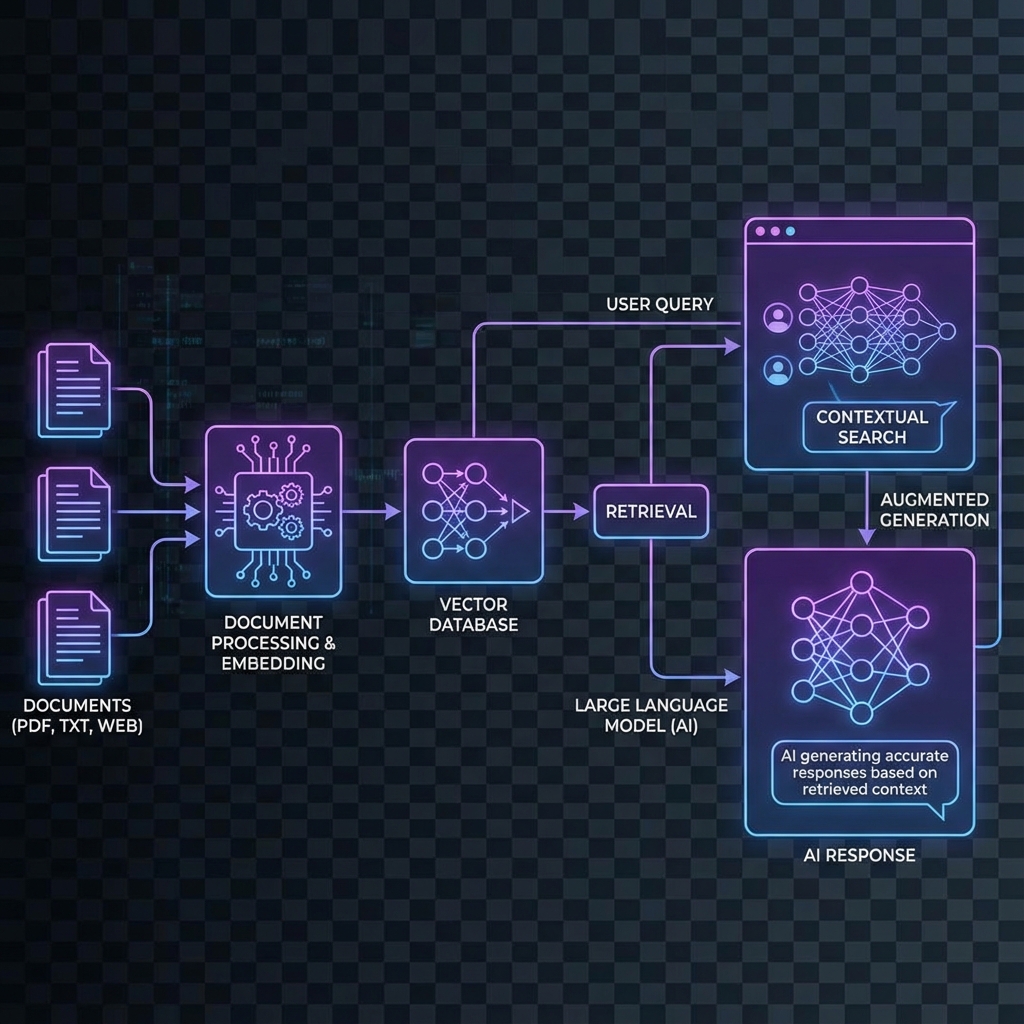
- The 3 Core Components of a RAG System
- Why Your Business Needs a Knowledge Base AI
- Step-by-Step: Implementing RAG for Your Brand
- Data Sources: What to Feed Your AI
- The ROI of 'Accurate' AI
- FAQ Section
What is RAG? (The Librarian Analogy)
Imagine you are at a massive university library.
- The "Model" (e.g., GPT-4) is like the Librarian. They are incredibly smart and have read millions of books. They have a massive vocabulary and understand complex logic.
- A Standard Chatbot is like asking the Librarian a question about a specific, private document in the restricted section. The Librarian hasn't read that document, so they "guess" based on general knowledge.
- A RAG Chatbot is like handing the Librarian a specific folder of your documents and saying: "Only use what’s in this folder to answer questions." When a user asks a question, the Librarian opens the folder, finds the right page, and summarizes it. Retrieval: Finding the right document. Augmented: Giving that document to the AI models. Generation: Writing the final answer. This is how a knowledge base chatbot stays accurate. It doesn't rely on its "memory" from 2021; it relies on the "open book" you just gave it. [INTERNAL_LINK: ttrain-ai-chatbot-on-my-pdf]
RAG vs. Fine-Tuning: Which is Better?
In the early days of AI, people talked about "Fine-Tuning"—training a model on your data. For 99% of small businesses, RAG is superior to Fine-Tuning.
| Feature | Fine-Tuning | RAG (Retrieval-Augmented Generation) |
|---|---|---|
| Cost | Expensive (Thousands of $$) | Cheap ($10-$50/mo) |
| Speed | Slow (Days of training) | Instant (Upload and go) |
| Accuracy | Prone to hallucinations | High (Cite-able sources) |
| Updates | Hard (Must re-train) | Easy (Delete old PDF, upload new) |
| Expertise | Requires developers | No-code friendly |
| [INTERNAL_LINK: no-code-ai-chatbot-builder] |
The 3 Core Components of a RAG System
To build a RAG chatbot for business, most platforms (like Tagnovate) use three layers:
- The Vector Database: This is where your PDFs are stored. They aren't stored as "text," but as "vectors" (mathematical coordinates). This allows the AI to find the "meaning" of a question, not just keywords.
- The Retrieval Engine: When a user asks "How do I join?", the engine finds the parts of your doc that talk about "signing up," "membership," and "pricing."
- The LLM (Large Language Model): The "brain" (like GPT-4o) that takes the retrieved text and turns it into a human-sounding reply.
Why Your Business Needs a Knowledge Base AI
The modern customer has "Search Fatigue." They don't want to Google you. They want to ask you. According to a study by Gartner, businesses implementing AI for customer experience see a 25% increase in customer satisfaction scores (CSAT). This is because RAG provides:
- Instant Answers: No waiting for a support rep.
- Zero Hallucination: The bot says "I don't know" if the info isn't in your docs, rather than making it up.
- Brand Consistency: The bot uses your terminology and tone.
Step-by-Step: Implementing RAG for Your Brand
Using a platform like Tagnovate, the implementation is as simple as uploading a file:
- Information Audit: Gather your most "support-heavy" documents.
- Knowledge Upload: Drag and drop into your Tagnovate dashboard.
- System Instruction: Tell the bot: "You are a helpful assistant for [Brand]. Use ONLY the knowledge base to answer."
- Test & Verify: Ask the bot questions from the perspective of a grumpy customer or a confused lead.
- Deploy: Add the bot to your link-in-bio or website. [INTERNAL_LINK: ai-chatbot-for-small-business-website]
Data Sources: What to Feed Your AI
Successful RAG customer service bots are fed a strictly "curated diet":
- Your FAQ Spreadsheet
- Your Service Level Agreement (SLA)
- Your Product Catalog
- Your Past Case Studies
- Your Website URL (for dynamic scraping)
The ROI of 'Accurate' AI
A small agency using a generic bot had a 40% "Bot Failure" rate (where the bot gave an irrelevant answer). The RAG Transformation: After switching to a Tagnovate RAG-powered hub, their failure rate dropped to under 5%.
- Customer Lifetime Value (LTV): Increased by 15% because clients felt supported 24/7.
- Operational Efficiency: The founder saved 12 hours a week that was previously spent correcting bot mistakes or answering "Where is the PDF?" emails.
Conclusion
RAG for small business isn't just a technical buzzword; it is the fundamental bridge between "Generic AI" and "Business Intelligence." By grounding your chatbot in your own data, you eliminate the risk of hallucinations and create a tool that is as reliable as your best employee. Don't let your AI guess. Give it the library it needs to succeed.
FAQ Section
Is my data used to train public models?
No. High-quality RAG providers like Tagnovate use "Enterprise API" endpoints that ensure your data remains your own and is never leaked to the public "brain" of ChatGPT or Claude.
How fresh is the data in a RAG bot?
It is as fresh as your uploads. If you change your pricing at 9:00 AM and re-upload your PDF, the bot knows the new price by 9:01 AM.
Can RAG bots handle images?
Many modern "Multimodal" RAG systems can now read images inside your PDFs (like charts or brand logos) and explain them to users.
Does RAG work for all languages?
Yes. Because the "Retrieval" layer works on the meaning of words, you can upload documents in English and have a user ask questions in Japanese—the AI will translate the concepts in real-time.
What happens if two documents contradict each other?
The AI will try to find the "best" answer. To avoid this, we recommend deleting old versions of documents when you upload new ones. {/* IMAGE SUGGESTIONS */}
- Hero: A "Librarian" metaphor infographic showing the flow of data from shelf to reader.
- Infographic: "RAG vs. Fine-Tuning" – a side-by-side comparison chart.
- Technical Diagram: "How RAG Works" – showing Vector Stores, Retrieval, and Generation layers.
- Screenshot: The Tagnovate "Vector Search" logs showing how the AI found a specific answer in a 50-page PDF. {/* SCHEMA SUGGESTION: Article, FAQ, HowTo /} {/ INTERNAL LINKS TO ADD */}
- [INTERNAL_LINK: ttrain-ai-chatbot-on-my-pdf]
- [INTERNAL_LINK: no-code-ai-chatbot-builder]
Tags
Ready to transform your link-in-bio?
Join thousands of creators using Tagnovate's AI-powered platform to engage visitors and boost conversions.
Start Free Trial